





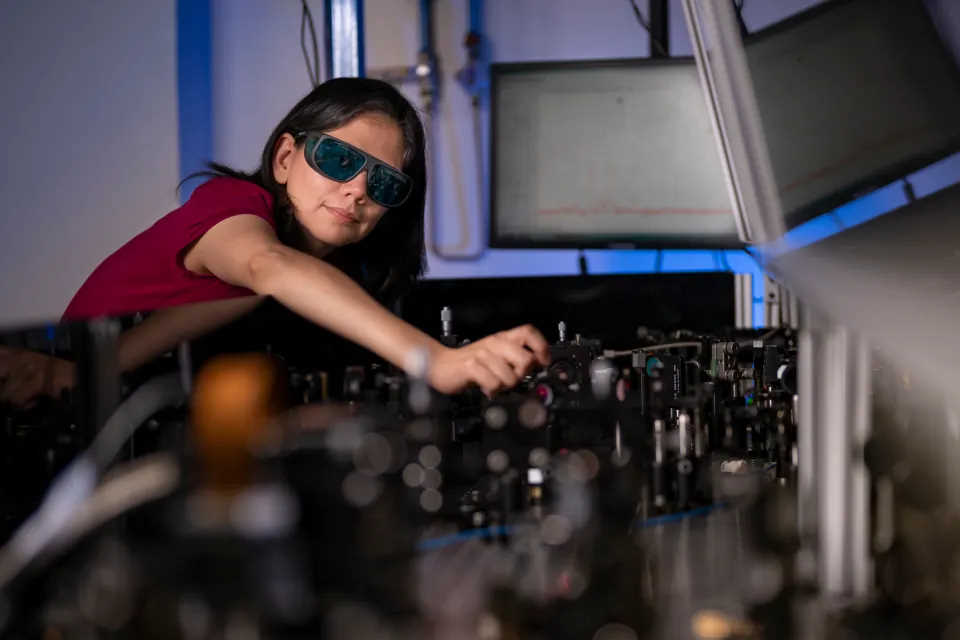
Researchers at the Australian National University (ANU) have developed an ultra-thin nanocrystal material that converts infrared (IR) into visible light, paving the way for lightweight and cheap night-vision spectacles.
ANU’s Dr Rocio Camacho-Morales said the technology will also have applications in optical tomography, food quality control and remote sensing, in a report published in Advanced Photonics. The innovation is the result of an international collaboration that included the Australian Research Council Centre of Excellence for Transformative Meta-Optical Systems (TMOS), the University of New South Wales and Nottingham Trent University in the UK.
In 1968, British Professor John Midwinter demonstrated that an image’s IR information could be converted to higher frequencies and detected using regular cameras in a process known as upconversion IR imaging. In 2016, Dr Camacho-Morales’ team reported on the capability of nanocrystals to perform this function and now her team has engineered the crystals into ultra-thin metasurfaces – a film that acts as a filter – which can be applied directly to spectacles.
ANU’s Professor Dragomir Neshev said it is the first time that IR has been successfully transformed into visible images in an ultra-thin screen. “It’s a really exciting development and one that we know will change the landscape for night vision forever.”