




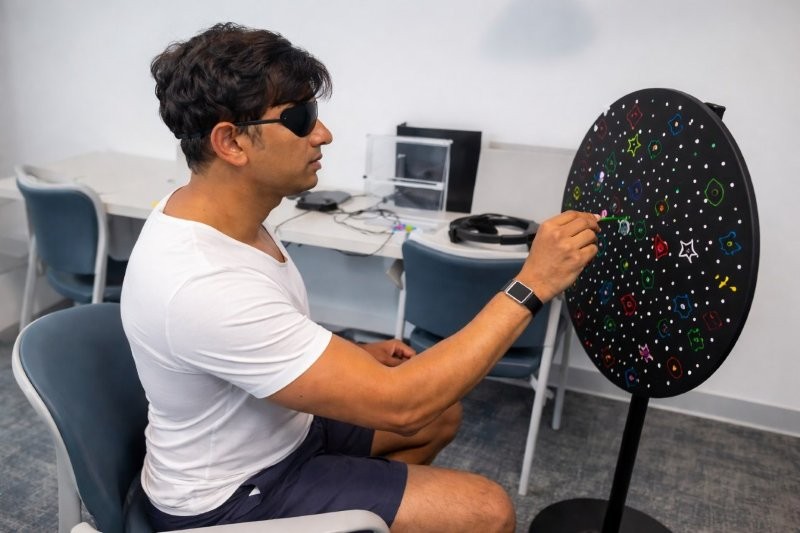
Drew Jones examines an ambitious vision-training model developed by US neuro-optometrist Dr Bryce Appelbaum, using UK GP Dr Rangan Chatterjee’s five-day experience and podcast interview as a case study.
Dr Bryce Appelbaum is challenging one of optometry’s core assumptions: that clear sight, measured on a letter chart, is the primary goal of eyecare. Instead, his ‘brain-based’ vision training programme, E, focuses on how the eyes coordinate, track and process information.
The approach, which sits outside mainstream refractive care, is gaining attention through high-profile advocates. These include UK GP Dr Rangan Chatterjee, who reported marked changes in his visual experience following five days of intensive training, including a reported shift in unaided distance acuity.
Dr Chatterjee, the author of several books, including number-one Sunday Times bestseller Happy Mind, Happy Life, interviewed Dr Appelbaum after completing his clinic-based programme, devoting an episode of his Feel Better, Live More podcast to the experience.
In the episode, ‘How to train your eyes & rewire your brain for better eyesight, sharper focus, improved memory & less stress with Dr Bryce Appelbaum’ Dr Chatterjee opens the topic by asking listeners, “Did you realise it’s not inevitable you’ll need reading glasses as you get older, even though it seems to be the modern-day norm?”
Dr Appelbaum, founder and CEO of MyVisionFirst, told Dr Chatterjee that his clinical focus is ‘brain-based’ vision therapy, rather than refractive correction. He said the programme is based on established vision therapy, vergence-accommodative therapy and sports-vision training techniques.
“Pretty much every eye doctor is heavy set on this pursuit of seeing 20/20 or 20/40 to allow somebody to see crystal clear at the far end of a dark exam room on this tiny letter chart,” said Dr Appelbaum. “But there is so much more to vision than just eyesight. Vision is how our eyes move together, converge, track, focus, process information – how we derive meaning from the world around us and then direct the appropriate action. So eyesight is a symptom. Eyesight is glasses or contacts. Vision is brain, and vision problems are brain problems,” he told Dr Chatterjee.
The visual system is one of the most neglected areas of human health, said Dr Appelbaum. “Vision is the new microbiome. We're going to look back on this in a few years and realise vision is responsible [for], or at least influences, so many aspects of longevity, consciousness, happiness, productivity, critical decision-making, even interpersonal connection.” He likened the “reactive, Band-Aid model” of optometry to prescribing a pre-diabetic patient medication instead of explaining the lifestyle changes that could reverse their progression.
Vision is our dominant sensory system and it should be what's guiding and leading and tying together input from all of our other senses to allow us to feel safe in space, said Dr Appelbaum. “If somebody is relying on their ears… to digest information, whether it's through audiobooks or a child preferring to be read to rather than reading on their own, very likely it's because it's hard to use all the delicate, intricate muscles that control our eyes… Using your eyes together as a team is so taxing and so fatiguing; it drains the system. It makes you want to fall asleep or disengage or find other means to try and still take in that information.”
ADHD, dyslexia, learning disabilities, mental health challenges and even executive functioning deficiencies all have a visual component, said Dr Appelbaum. “So often in the medical world, [such] labels are slapped on behaviours without looking into their root cause. And functional vision problems have so many of the same symptoms and behaviours as so many of those labels.
“If we think about eye movements across the midline – which is the tracking eye movement that would intimately correlate with losing our place with reading, skipping words or skipping lines – any change in eye movement, whether it's voluntary or involuntary, is a change in attention. And if you can't control your eye movements, you can't control your attention.”
He suggested a child in a classroom might not be looking at the teacher when they're talking because it's so hard for them to take in all the sensory input from around them. “They're relying on their ears, not their eyes. They may be listening and fully engaged with everything that's going on in the classroom through that processing system, but they're going to be mislabelled as somebody who has ants in their pants because they need this motor overflow, or because it's so hard for them to copy from the board to their page because they don't have the flexibility with their eye coordination systems.”
Antisocial screens
If a person is looking at the sea while on holiday and they have that soft peripheral vision where they can see as far as the eye can see, it’s a way of activating the parasympathetic nervous system and promoting relaxation, said Dr Chatterjee. “But when the human visual system is under stress, the autonomic nervous system is primed for a fight-or-flight response, our pupils widen and we lock in with tunnel vision,” said Dr Appelbaum.
It's meant to do that, to protect yourself from danger that's coming at you so you can react, he said. “[It’s evolved so that] you're blocking off everything that doesn't matter, other than that sabre-toothed tiger coming at you. This is what's happening with our world that's now been brought within arm's length. When we're on screens, our vision, our thinking, our attention become tunnelled.”
The average American adult spends seven hours and four minutes a day on a screen, with the average American eight- to 10-year-old spending six hours a day on a screen, he said. “What that means is we're promoting the stress response and shifting how our brain is functioning. So people are making critical decisions for work under a state of fight-or-flight. People are not able to think outside the box.”
In fact, the social implications are far broader than that, said Dr Appelbaum. “A lot of 20-year-olds and teenagers have difficulty maintaining eye contact because they haven't had the interpersonal connection that comes with being away from screens and communicating in the real world. They have trouble controlling their eye movements; they have trouble looking at somebody without having to look away or even just maintaining eye contact. Or when they're looking at someone, they're thinking, ‘Do I look at the left eye or the right eye or the nose or the mouth, because I can't take in the whole picture’.”
In the podcast, Dr Chatterjee discussed a 2024 documentary, Swiped: The School that Banned Smartphones, which he made with the UK’s Channel 4. Following a class of 12- and 13-year-olds, producers took away their smartphones, laptops and gaming devices for 21 days. “We measured everything with the University of York. [Over the 21 days] depression and anxiety got better… they felt more socially connected… they were sleeping an hour extra per night. And [something that didn’t make the TV edit] was [measurement of] heart rate variability, a marker of stress on the body. High HRV, generally speaking, is a good thing, and it went significantly up after two to three days.”
There is clear research showing myopia is increasing at an alarming rate in countries that value technology in education, said Dr Appelbaum. “And the three main risk factors are: not enough time outdoors with natural sunlight, poor lighting levels for near work and prolonged near visual stress in the form of too much screen time. When we landed on the moon in 1969, a quarter of America was nearsighted. Right now, it's at about 43% and climbing.”
He also highlighted the role modern LED lighting plays in visual stress. “The flicker frequency of junk [artificial] lighting creates a sensory overload for so many people. Blue light is actually not bad for us. But that's natural blue light to help regulate circadian rhythms and mood and alertness, which is why first thing in the morning, last thing before bed, it's great to get outside, get some movement in. But this artificial blue light that's blasting our eyes all day long, that's telling the specialised cells in the back of our eye, whose sole job is to signal the release of melatonin, to let you know whether you're asleep or awake.”
Training days’ results
Dr Chatterjee attended Dr Appelbaum’s programme in the US, completing 12 hours of “active work” across five days. “We measured the exact same way today, exact same room, exact same person,” said Dr Appelbaum, who found Dr Chatterjee’s unaided distance acuity improved from 20/400 on day one to 20/70 on day five.
Dr Appelbaum framed the shift as a functional change in eye-brain control, rather than simply chasing clearer letters, emphasising accommodation in particular. “Like an old-school camera lens, we want that system to be on autofocus. When we met on Monday, that was stuck on manual focus.”
He said the aim was to rebuild stable binocular coordination and depth processing, with clearer control of distance in front of the observer. “You’ve now developed a clear rapport with what’s in front of you… you’ve learned how to lock in and see things clearer at different distances.” He added that Dr Chatterjee’s “spatial mismatch has been dramatically improved”.
A key early finding in Dr Chatterjee’s vision was binocular competition that pushed the system into a ‘one-eye-at-a-time’ strategy, said Dr Appelbaum. “There were so many times where because of this rivalry over sensory input, your brain was saying, ‘I can’t use both of my eyes together’. So you were using one eye for near and one eye for far.”
Dr Chatterjee said within a day of finishing his training he’d noticed a heightened awareness of peripheral processing. “It’s as if a switch had been flicked on in my brain. I had a different dimensional experience of the world.”
Dr Appelbaum and his team have also developed an online vision wellness programme, ScreenFit, designed to – some might consider ironically – reduce screen fatigue with 15-minute daily eye exercises on a phone, laptop or tablet.