




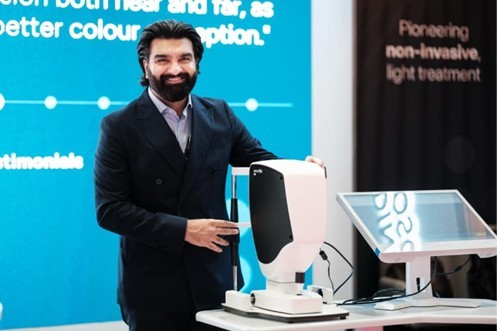
The developer of Revisyon, a light-based device designed to treat early cataracts, has responded to New Zealand eyecare professionals’ concerns about its safety and effectiveness.
Developed by Edinburgh Biosciences, Revisyon uses specific wavelengths of low-intensity light to trigger chemical changes in lens proteins. The aim is to restore those proteins’ natural structure, reducing light scatter and improving vision. The company said this process allows light to pass through the lens more clearly, resulting in brighter, sharper vision.
However, the technology has drawn scepticism from clinicians. In October 2025, Hamilton surgeon Associate Professor James McKelvie said, “At best, it may be a temporary solution that could be very expensive,” and questioned the company’s comparisons with cataract surgery at the time, describing some as “incorrect or overstated”. Dr Peter Hadden also raised concerns about the underlying science, noting that light below 320nm, which has sufficient energy to alter molecules, cannot pass through the cornea. “If used, such light could risk DNA mutations and cancer,” he warned.
Responding to these criticisms, Edinburgh Biosciences chief commercial officer (CCO) Alok Machchhar said the company welcomes inquiry. “We recognise that innovative approaches in eyecare naturally attract questions and scrutiny, particularly when the clinical data have not yet been published,” he said.
He stressed that Revisyon is not intended to replace cataract surgery. “Rather, it is being developed as a non-invasive treatment option for patients earlier in the cataract pathway, particularly those who are not yet ready for surgery.”
Machchhar said Revisyon’s Photon Protein Modulation technology does not use laser energy but controlled low-intensity light within recognised ophthalmic safety limits. “[Revisyon] aims to act on aggregated lens proteins through a mild, slow photochemical process. The device operates within visible to near-visible wavelength ranges at low energy levels, without thermal or ablative effects.”
He added that references to ultraviolet light in earlier company literature relate only to experimental models used to study cataract formation, not to the treatment itself. “In clinical application, the crystalline lens absorbs the delivered wavelengths, resulting in minimal transmission to the retina, around 1–2% of the total energy, and exposure levels well within established safety limits.”
Peer-reviewed study expected soon
Machchhar said the company has now completed long-term follow-up of clinical evaluations assessing safety and efficacy. Results from a 240-patient study are being prepared for peer-reviewed publication. “We expect to share these findings later this year. We believe the published data will provide important clarity around the safety profile and clinical outcomes associated with the technology.”
Until then, the evidence base consists of early clinical studies. A first-in-human EU pilot study involving 11 patients assessed safety and feasibility over a four-week treatment course comprising eight sessions. “The procedure was well tolerated and no serious adverse events were observed, supporting progression to larger-scale evaluation,” he said.
A subsequent EU multicentre study of 92 patients showed statistically significant improvements in visual acuity and cataract grading. Mean improvement in best-corrected visual acuity was approximately 2.3 lines, with 66% of patients gaining more than two lines and 20% achieving logMAR 0.0, equivalent to 6/6. “In addition, a substantial proportion of patients transitioned into higher functional vision categories.”
Improvements in lens opacity were also reported. “Reductions in nuclear colour, nuclear opalescence and cortical opacity were statistically significant, while posterior subcapsular changes did not reach statistical significance. The treatment effect appeared more pronounced in patients with early-to-moderate cataract, particularly those with baseline visual acuity in the range of 0.3–0.5 logMAR.”
No serious adverse events have been reported across studies to date, he said. “At one study site, four adverse events were recorded, all of which resolved without sequelae.” Broader safety assessments, including OCT, mfERG, microperimetry, endothelial cell counts and intraocular pressure, identified no clinically significant safety signals.
With the company working towards regulatory milestones, including UK Conformity Assessed and CE approvals, Machchhar emphasised that Revisyon remains investigational.